A critical message sent by email that disappears among dozens of threads, a new procedure that employees do not confirm they have read, and a manager who discovers too late that an employee did not receive essential information - these are not just communication failures. They create delays in processes, harm management consistency, and make it harder for the organization to prove what was delivered, to whom, and when. An organizational internal communication management system is needed to turn communication from a one-time action into a measurable, documented operational process connected to employees.
In medium and large organizations, internal communication does not happen in a single channel. There is an organizational portal, email, messaging groups, payroll systems, ERP systems, field managers, and mobile employees. When each channel operates separately, the HR department invests significant time searching for information, sending manual reminders, and checking whether a message actually reached its destination. The solution is not necessarily to add another communication tool, but to create a work environment that connects messages, audiences, processes, and employee data.
What an organizational internal communication management system needs to solve
The central need is control. Not control of content alone, but the ability to define who should receive a message, at what time, in what language, and in what employment context. An update for the entire company differs from a message to employees at a specific site, a message to new managers, or a reminder to employees required to complete a periodic evaluation.
A proper system enables segmenting the target audience according to existing organizational data: unit, role, location, tenure, direct manager, employment status, or permission group. This way it is possible to reduce flooding with irrelevant information and ensure that important messages reach exactly the people who need to act.
The second requirement is traceability. Email provides partial open data, but usually does not connect reading the message to the action required afterward. In meaningful organizational communication - confirming a procedure, registering for an event, completing a survey, uploading a document, or completing a task - a clear sequence is required: sending a message, receipt, confirmation, action, and reporting to the manager or the HR team.
The third requirement is context. A message about an employee evaluation should not stand on its own. It should lead the manager to the appropriate form, display the due date, trigger reminders when needed, and document completion of the process in the employee file. This is the difference between a publishing channel and a system that drives execution.
From an organizational portal to a connected work process
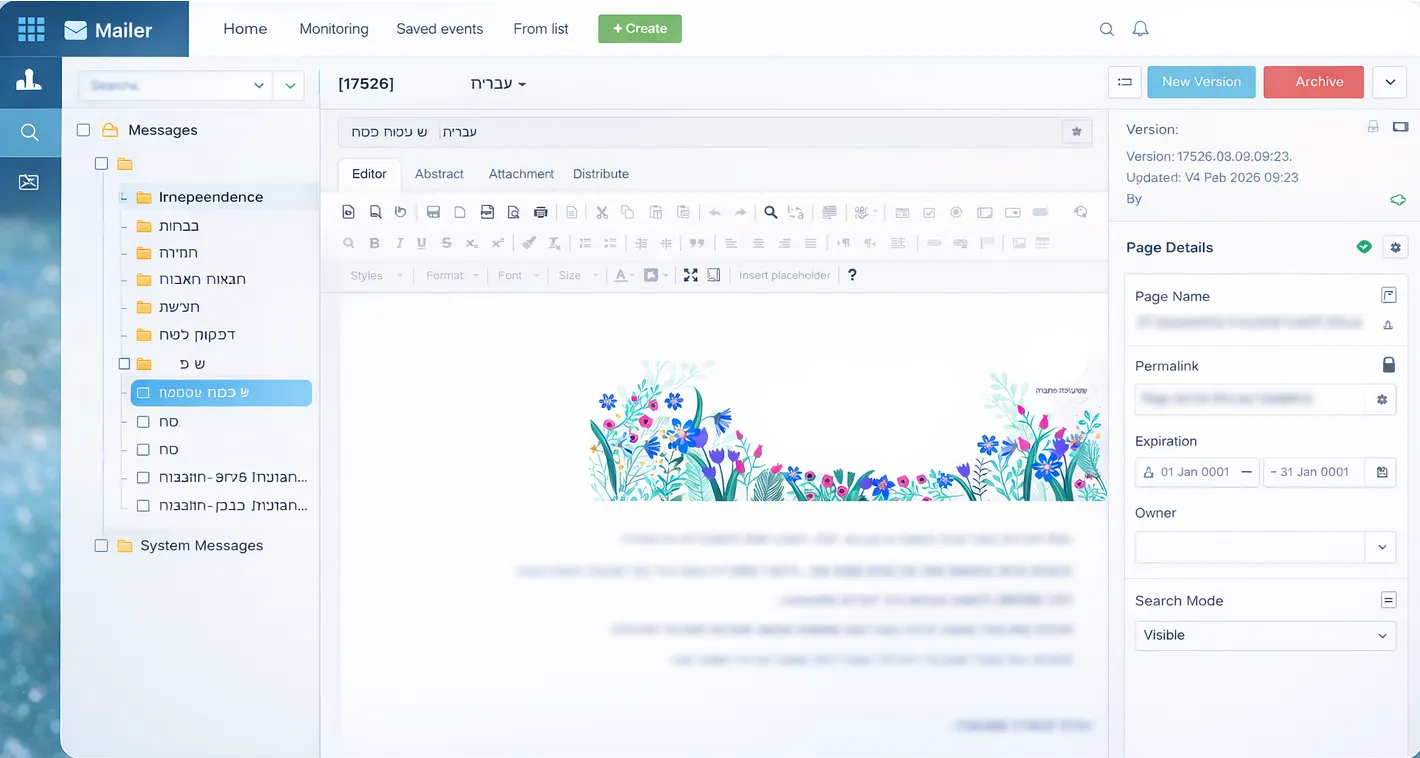
An organizational portal is often the natural starting point for internal organizational communication. It centralizes news, procedures, forms, events, and useful information for employees. But a portal without permission management, integration with workforce data, and the ability to run processes behind it can quickly become a digital bulletin board that few enter on their own initiative.
For the portal to be an operational tool, it must present each employee with content tailored to their role and to the stage they are in within the organizational life cycle. A new employee needs onboarding tasks, familiarity with procedures, and contact details. A team manager needs alerts about evaluation tasks, leave approvals, or documents awaiting their attention. A veteran employee may receive a policy update notice, an invitation to an event, or a request to participate in an engagement survey.
The adaptation is not only a better user experience. It reduces manual work, lowers distribution errors, and makes it easier for the organization to meet control and documentation requirements. When the organizational structure and employee details are fed from payroll or ERP systems, distribution lists do not depend on Excel files that quickly become outdated.
Communication is part of the employee life cycle
Value grows when communication is connected to core HR processes. In onboarding, for example, the employee and managers receive a series of tasks and messages according to the start date. In a performance evaluation process, the system reaches out to the manager and the employee, tracks completion stages, and centralizes the information in the employee file. In an organizational survey, it enables distribution to precise audiences, participation tracking, and results analysis.
This approach also creates a uniform management language. Instead of each manager drafting reminders independently and tracking them in a different way, the organization defines templates, deadlines, approval paths, and escalation factors. There is still room for manager flexibility, but the critical actions are performed within a controlled framework.
Where organizations encounter failure
The common mistake is to treat the communication problem as a distribution problem alone. Therefore a tool is chosen that knows how to send messages, but does not know how to connect to the organizational structure, update status in a process, or present a complete picture of the employee. The result is another system that requires maintenance, another interface for employees, and another information source that is not always synchronized.
Another failure is implementation without a clear definition of ownership. Who approves an organizational message? Who maintains target groups? Which information requires read confirmation? Who receives an alert when a task was not completed? Without clear answers, even an advanced system will reflect the existing disorder instead of reducing it.
There is also a real tension between accessibility and control. If every employee can publish to the entire organization, flooding occurs. If every message requires a long approval chain, the information arrives too late. The solution depends on the organization's structure, but it is usually right to define layers: free publishing within teams or defined communities, versus controlled organizational publishing for mandatory messages.
Capabilities worth examining before choosing a system
When choosing a platform, it is worth checking the system's ability to support communication over time and not only for a campaign or a single project. Five capabilities are the basis for a professional decision:
- Integration with employee data - synchronization with payroll and ERP systems so that units, roles, managers, and statuses stay up to date.
- Segmentation and permissions - defining precise audiences and different access for employees, managers, HR, and other role holders.
- Process automation - triggering messages, reminders, and tasks based on an event, date, status change, or an action that was not completed.
- Measurement and documentation - the ability to see delivery, read confirmation, action completion, and exceptions that require attention.
- Mobile accessibility and cloud security - a usable experience available to employees outside the office, alongside a reliable infrastructure and organization-level information permissions.
It is also important to examine implementation speed. A project meant to improve communication but requiring long months of custom development may miss an immediate business need. On the other hand, implementation that is too fast without defining processes, ownership, and success metrics will lead to partial adoption. The goal is a practical configuration based on proven product capabilities, with adaptation to the organizational structure and the local working language.
Metrics that show whether communication really works
An open rate alone is not enough. A message can be opened without being read, and read without leading to action. The metrics should be connected to the business goal: onboarding task completion rate, percentage of managers who completed evaluations on time, survey response, inquiry handling time, procedure confirmation rate, or the number of manual reminders saved for the HR team.
It is also worth examining quality, not just speed. If the completion rate rises but employees report alert overload, an adjustment of frequency and segmentation is required. If managers meet deadlines only after a large number of reminders, the process itself may be too complex. A good system provides the data, but the management decision determines how to improve them.
AI as management support, not a substitute for responsibility
AI tools can help summarize feedback, identify recurring themes in surveys, and suggest wording or follow-up actions for managers. Their value is especially high when information is scattered across evaluation processes, forms, and ongoing communication. However, an automatic recommendation is not a substitute for the judgment of a manager or an HR team.
Clear permissions must be defined, information privacy preserved, and recommendations based on relevant and approved data. Effective AI is an assistance layer within an orderly process, not a shortcut that bypasses it.
B2E connects an organizational portal, digital employee file, evaluation processes, surveys, events, and automation into one environment. For an organization that already manages employee data across different systems, this connection makes it possible to turn scattered messages into documented processes with a complete operational picture.
The right step is not to start with the question of which communication channel is missing, but to identify which processes get stuck because information did not arrive, an action was not documented, or responsibility was unclear. From there it is possible to define communication that works for employees - and especially for organizational execution.