
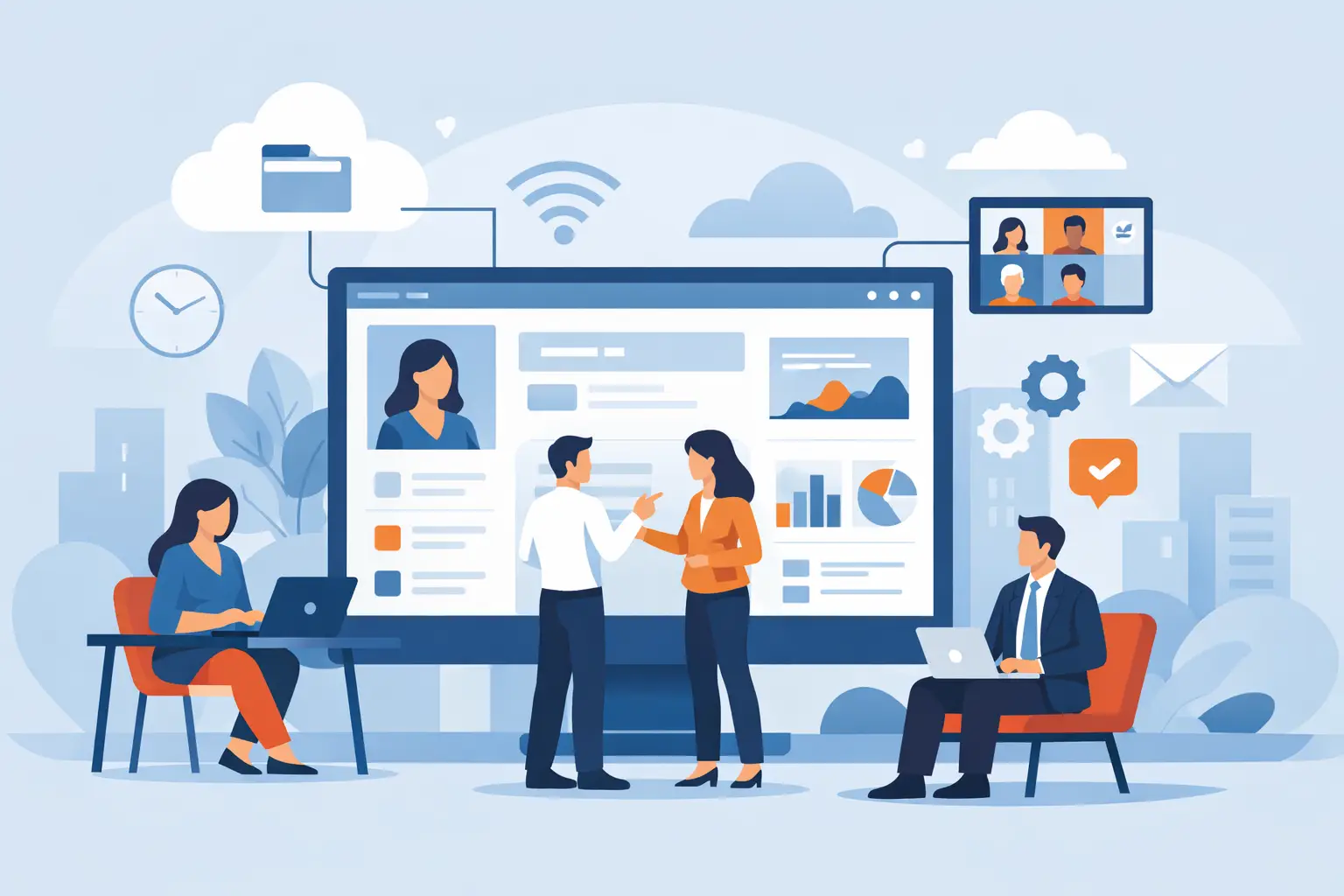
When an employee needs to open a slip, a manager needs to approve a process, and HR needs to update a document - but each action is performed in another system, in another email or in another file - the problem is no longer just convenience. This is an operational problem. An organizational portal for employees is designed to solve exactly this point: to centralize access, information and processes in one environment that works at the pace of the organization and not against it.
In medium and large organizations, the portal is no longer an internal communication channel. It is the daily work layer of the employees, managers and headquarters officials. When built correctly, it reduces friction, improves control and gives HR teams back time that would have been burned on follow-ups, repeated questions and manual work. When it's built wrong, it becomes another system that no one really wants to open.
What is an organizational portal for employees
A corporate portal for employees is an internal digital work environment that centralizes for the employee and managers what they need to do, know and approve. This typically includes personal documents, forms, applications, organizational updates, assessment processes, surveys, event registrations, tasks and internal service interfaces.
But the real difference is not in the list of abilities but in the way they connect. A good portal doesn't just "present information". It connects employee data, approval flows, intra-organizational communication and core systems such as payroll and ERP. In this way, one gets a clearer picture of the employee and what happens around him throughout the organizational life cycle.
This is also the reason why not every intranet is an effective corporate portal. A classic intranet often focuses on content and news. An enterprise portal for employees should serve actual work - not just communication, but execution.
Why organizations today invest in an organizational portal for employees
In most organizations, the problem is not a lack of systems but an excess of disconnected systems. A payroll system sits in one place, an employee portfolio in another, performance evaluations in a third tool, and surveys or forms are sent through point solutions. The result is known: lack of uniformity, duplication, uncertainty about the current figure, and operational burden on HR and managers.
A corporate portal for employees narrows this gap because it creates a single entry point for corporate activity. For the employee, this means less searching and more execution. For the manager, this means faster access to tasks, statuses and relevant information. For management and HR, this means being able to manage processes, see a situational picture and track actual performance.
There is also an aspect of adoption here. Employees do not want to learn five systems to perform basic operations. If the organization wants continuous use, it should submit the main operations in a clear interface, also available on mobile, and as close as possible to the working language of the users.
What a good portal should actually include
You should start with the simple operational question: which tasks happen every week, every month, and at every station in the employee's life cycle. From there build the portal. Not from the most beautiful features, but from the real burdens in the organization.
At a basic level, the portal should provide secure access to personal documents, forms and processes. At the more advanced level, it should support workflows such as employee onboarding, approvals, performance appraisals, organizational surveys, events, and targeted communications by role, unit, or population.
The really critical element is context. If a manager logs into the portal to complete an employee evaluation, he doesn't have to jump between files, emails and systems to understand the picture. When the information is connected - employee data, process history, open tasks and relevant summaries - decisions are faster and more accurate.
Digital Employee Portfolio as part of the portal
One of the most practical uses is connecting the portal to a digital employee portfolio. Instead of scattered files and dependence on HR personnel for every document or status, the employee gets controlled access to his personal information, and the organization gets better control over updates, permissions and documentation.
This is important not only for efficiency but also for meeting organizational and regulatory requirements. The more centralized and consistently managed information is, the easier it is to enforce policies, preserve history, and reduce errors.
evaluation processes, surveys and events in one place
In many organizations, feedback and evaluation processes are still semi-manually managed. This creates congestion, delays and gaps in quality. When the portal includes evaluation mechanisms, status tracking, summaries and reminders, the process goes from spotty and frustrating to ongoing and manageable.
The same principle is also true for organizational surveys, registration for events and internal communication. Instead of working with a different solution for every need, it is better to create a unified work environment where each component strengthens the other. This also increases the chance that employees will actually use the platform continuously.
Where portals fail
The most common failure is to treat the portal as a content project instead of an operational system. If most of the investment goes to designing the home page and publishing announcements, but the core operations are still performed manually or in separate systems, the value remains very partial.
Another failure is too slow assimilation. In stressed organizations, a project that drags on for months loses internal momentum. By the time the system goes up, the needs have already changed, the stakeholders are tired, and trust is declining. Therefore, application speed is not a bonus - it is part of the business value.
There are also times when the portal is too busy. Trying to put everything in at once hurts the user experience. The employee wants to understand immediately where an action is being taken, what awaits him, and which tasks are currently open. If the interface is busy or not optimized for mobile, usage rates drop quickly.
How to choose an organizational portal for employees that is suitable for the organization
The right choice starts less with the question "how many modules are there" and more with the question "which operational problem do we want to solve first". There are organizations where the bottleneck is the absorption and recycling of employee portfolios. In others, the main problem is employee evaluations, internal communication, or multiple systems that don't talk to each other.
Therefore it is correct to examine the solution according to four dimensions. The first is integration - does the system know how to connect to payroll systems, ERP and other organizational information sources. Without it, the portal remains a partial view layer. The second is operational depth - is it really possible to manage processes, approvals, forms and tracking, or is it mainly an improved internal organizational site.
The third is application speed. If a long development project is required for each basic adjustment, it is difficult to generate value quickly. The fourth is usability - whether employees and managers will immediately understand what to do, even without heavy training, and whether the experience supports mobile work.
This is exactly where an integrated solution gives a clear advantage. Instead of collecting separate tools for an employee portfolio, assessments, surveys, portal and workflows, it is better to work with a platform that connects them in advance. For management and HR this means less maintenance, less information gaps and more end-to-end control.
The business value of an organizational portal for employees
The first metric you usually see is time savings. Fewer repeated inquiries to HR, less chasing after approvals, fewer versions of files and more processes that progress on their own according to clear rules. But this is only the first step.
The deeper value is the quality of management. When managers get quick access to data, open processes and employee history, they manage better. When HR sees a more uniform picture of personnel processes, it is easy for it to identify delays, performance gaps and points for improvement. And when the management gets a more reliable layer of control, it is easier to decide based on information and not based on feeling.
There is also a direct impact on the employee's experience. Not in the password sense, but on a practical level. An employee who finds what he needs, performs actions without waiting, and receives relevant communication in one place - experiences a more organized organization. It affects trust, speed of execution, and how the organization is perceived internally.
Not every organization needs the same portal
This is the place to be precise: there is no one model that fits everyone. An organization with a multi-site deployment, field population, and multiple managers needs a different structure than a hybrid headquarters organization. A fast-growing company will prefer a solution that can be expanded without re-establishing the entire process. An organization with high control requirements will place greater weight on permissions, documentation and data consistency.
Therefore, the right choice is not the portal with the most options, but the portal that correctly connects needs, processes and infrastructure. If it provides employees with a clear access point, managers with the ability to act, and HR with lateral control - it does the job.
Organizations looking for a quick result and practical implementation tend to prefer a unified, cloud-based platform with compatibility for mobile and connection to existing systems. This is also the direction in which B2E operates - not as another one-off tool, but as a connected work environment that centralizes HR processes and internal organizational operations under one system.
In the end, an organizational portal for employees is neither an image project nor an additional layer of communication. is an operational decision. When built around real processes, with a connection to the data and tasks the organization already manages, it starts generating value almost immediately - and that's exactly what HR teams, managers and executives need to see from the next system they adopt.
