
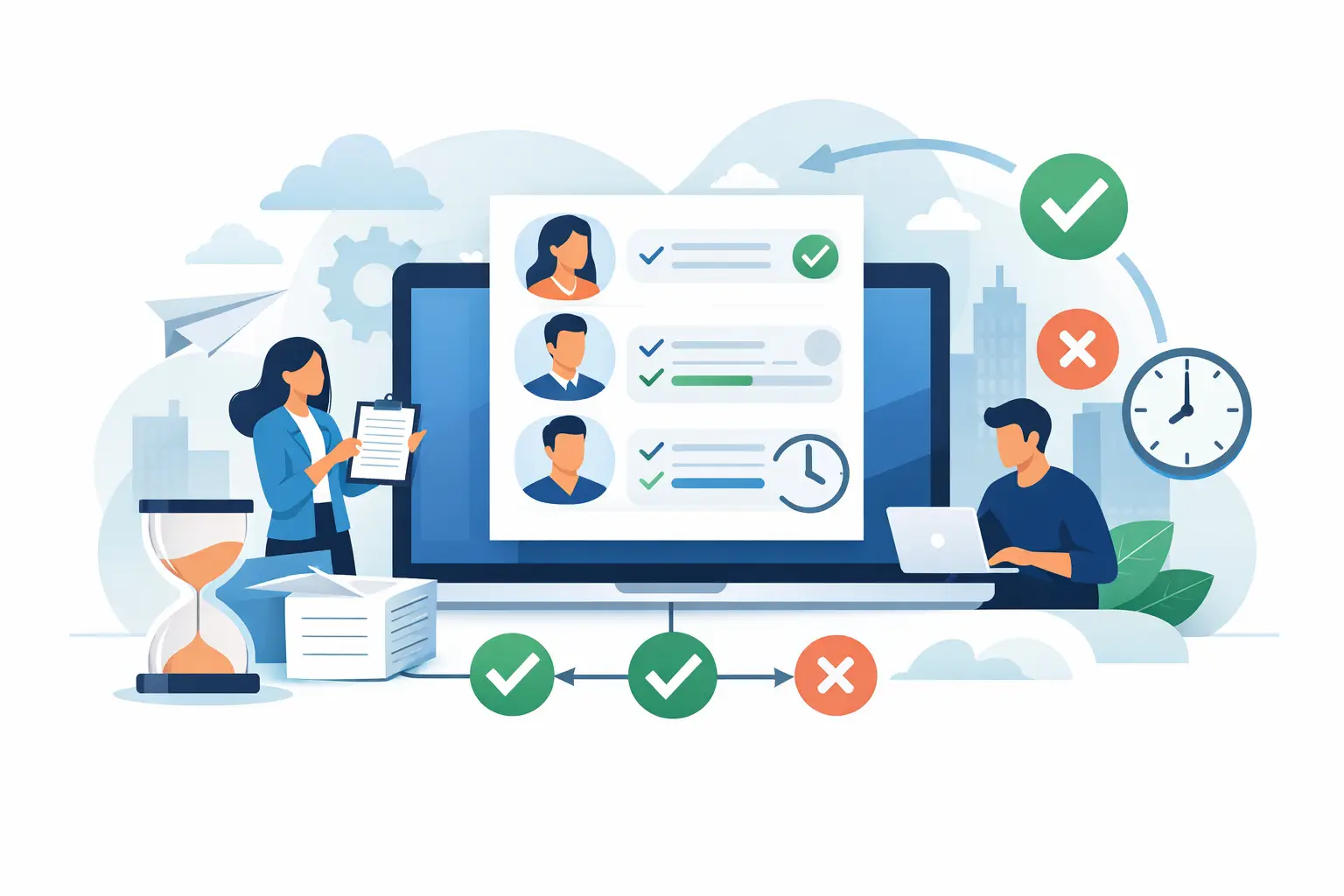
A request for a salary increase, approval of a new standard or departure for training should not disappear in a manager's mailbox. And yet, in many organizations this is exactly what happens: the request is opened in a file, passes between several officials, returns for corrections, and remains without a clear status. Approval process management system replaces the route of messages and files with a measurable digital process, where each request reaches the right party, with the right data and at the right time.
For HR departments, it's not just about operational convenience. An approval process is a meeting point between organizational policy, employee data, budget, management hierarchy and documentation requirements. When this connection is managed manually, errors and delays become almost inevitable. When it is managed on one platform, you can have full control without burdening managers and employees.
Why manual approval processes create a bottleneck
An approval process based on email, forms and Excel files seems simple as long as it involves a small number of requests. As the organization grows, it becomes complex: who approves first, what happens in the absence of an approver, what documents must be attached, and what is the latest figure on which the decision is made?
The problem is not just the duration. A decentralized process produces decisions that are sometimes based on partial information, difficulty proving policy compliance, and a gap between what was approved and what was actually updated in the payroll systems, the ERP or the employee's digital file. The HR manager may know that a request has been submitted, but not know where it is stuck. A manager may approve a change in role without seeing the relevant professional history, goals or performance evaluations.
The price is also felt in the employee's experience. When an employee or manager cannot see whether a request has been accepted, rejected or is awaiting further approval, they repeatedly contact HR. Instead of engaging in organizational development and professional decisions, the team becomes a focus of inquiries.
What an approval process management system should manage
An effective system is not satisfied with a digital form and a confirmation button. It manages the entire life cycle of the application: opening, normality checks, routing, decision, documentation, updating in the relevant systems and monitoring of anomalies. Each step should be adapted to the organizational logic and not to the constraints of a generic tool.
For example, a recruitment request can go from a hiring manager to a unit manager, to HR and to budget. But the route is not always the same. If it is an existing standard, additional budgetary approval may not be required. If it is a management role or unusual ownership, an additional approval step is required. A good system knows how to activate these conditions automatically, without requiring the employee to understand the rules of the organization behind the scenes.
This is also the case in the processes of salary changes, job changes, hybrid work, promotion, departure for training or approval of an exception in the policy. The request should be opened from the context: the employee, the manager, the organizational unit, the salary or evaluation data, and the documents that already exist in the employee's file. This is the difference between a disconnected process and a process that enables a professional decision.
Correct data before confirmation
Fast approval is not necessarily good approval. If a manager receives a salary change request without data on current salary, job range, performance evaluation or budget framework, he is required to supplement information from other sources. The action may be performed in the system, but the decision is still conducted outside of it.
In a connected enterprise platform, it is possible to show the approver only the data he needs according to authorization. A direct manager sees the details of his employees; A senior manager sees the single picture; HR can review history and policy compliance; and finance get the budgetary aspects. Precise permissions enable operational transparency while maintaining privacy.
Dynamic tracks instead of a uniform process for everyone
Trying to impose one approval route on all types of requests usually leads to two results: either the process is too slow, or it is full of manual shortcuts. Correct processes are built according to the type of request, the characteristics of the employee, the unit, the cost, the level of the exception and the required permissions.
This flexibility is especially essential in an organization with several subsidiaries, sites, business units or local policies. Next to a uniform organizational framework, controlled adjustments should be allowed. In this way uniformity is maintained in reporting and documentation, without producing a solution that is not suitable for actual work.
The processes where the value is felt immediately
The benefit of an authorization management system is particularly evident in processes with a high number of participants, information and sensitivity. In many organizations, the starting point is processes where the handling time directly affects the business activity or the employee experience.
Among the particularly suitable processes can be found:
- Hiring approvals, job opening, standards and replacement of employees.
- Salary changes, grants, promotions and job changes.
- Approval of unusual vacations, remote work, overtime and special absences.
- Requests for trainings, certifications, professional trips and expense reimbursements.
- Signing of documents, updates of personal details and processes of absorption or termination of employment.
The list does not require digitizing everything on the first day. Sometimes it is right to start with one process that produces a significant load, measure the result, and then expand. A tiered approach reduces objections and makes it possible to fine-tune the screens, notifications and routing rules according to actual use.
Integration is part of the process, not an addition
A certificate system that is not connected to the central data sources may create an additional repository that requires manual maintenance. Therefore, in a medium or large organization, the connection to payroll software, ERP, attendance systems and the employee management system must be examined.
The connection is not only for importing data. It allows the approval process to end in operational action. For example, after a job change is approved, the data can be updated in the [employee file] (https://www.b2e.co.il/products/hr-system) and the relevant systems in accordance with the rules of the organization. Once Employee Evaluation is approved, the decision, feedback, and follow-up tasks can be saved in one place. This way you reduce double typing, prevent gaps between systems and maintain a reliable data source.
B2E connects work processes, a digital employee portfolio, employee evaluations and organizational tools in the same cloud environment. For HR teams, this means that approval is not an isolated event, but part of a complete operational picture of the employee and the organization.
Metrics that turn the process into a management tool
One of the significant advantages of digitization is the ability to see where the process is really delayed. Without data, organizations tend to assume the problem is general congestion. In practice, it is possible that a certain request type returns repeatedly to complete details, that a certain approver receives notifications too late, or that an approval route includes a step that is no longer necessary.
It is useful to monitor the average processing time by type of request, the rate of requests that return for correction, the number of deviations from policy, requests that wait beyond the defined time, and the division of loads between approvers and units. These indicators make it possible to improve the process itself, and not just speed up the handling of the next request.
Use of alerts and escalations should also be measured. A reminder to the approver can shorten processing times, but an excess of notifications causes it to be ignored. It is correct to define target times, graded reminders and a transfer mechanism to an alternative agent in case of absence or exceeding the treatment time.
How to choose a solution that suits the organization
Before choosing a system, it is important to define what decisions the organization wants to manage and what information is required for each decision. Not every process has to be complex, and not every simple process has to become a development project. The goal is to produce clear, controllable routes that are easy to update when policy or organizational structure changes.
Check the ability to define forms, conditions, permissions and approval routes without constant dependence on development. We also looked at compatibility for mobile, since a large part of the approvals is done away from the desktop. At the same time, make sure there is complete documentation of decisions, time stamps, comments and changes, as well as a secure cloud infrastructure that fits the organization's requirements.
The speed of application is important, but it does not stand on its own. Implementing too quickly without cleaning up existing processes may simply transfer the confusion to a new system. Conversely, a project that is too long loses business support. The right balance is a focused mapping of critical processes, a clear definition of role holders, and a quick launch with the ability to expand.
When approval becomes part of regular work
An organization is not measured only by the quality of the decisions it makes, but also by its ability to make them on time, based on complete information and in a way that can be explained and audited. A clear approval process gives managers independence, HR teams control, and employees certainty about what is happening with their request.
You should start where the wait is most noticeable: requests that occupy human resources, delay managers or create a lack of transparency. When one process transforms from a scattered email into a measurable and data-connected track, it is easier to build a new organizational standard - one that promotes fast, responsible and clear work.