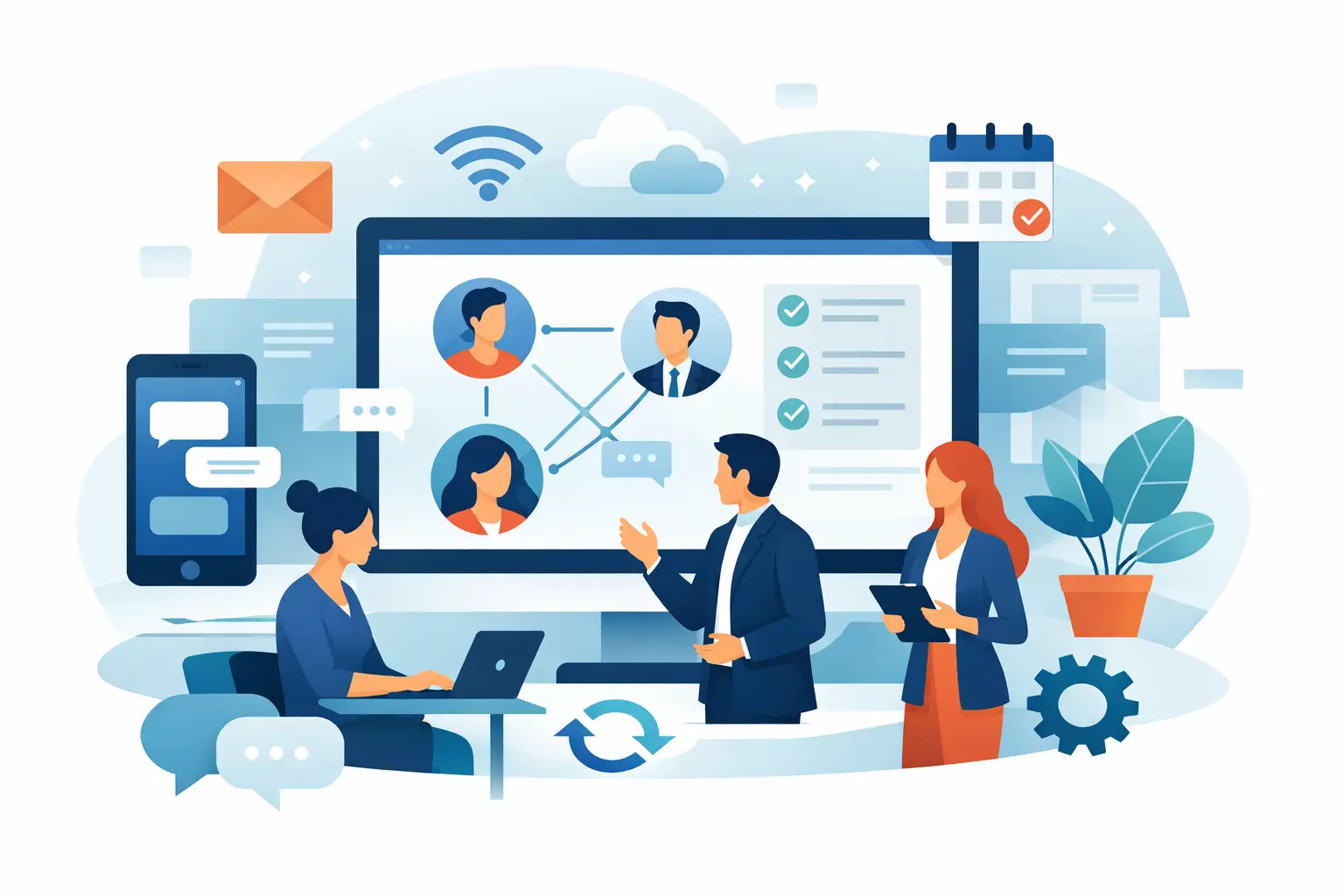
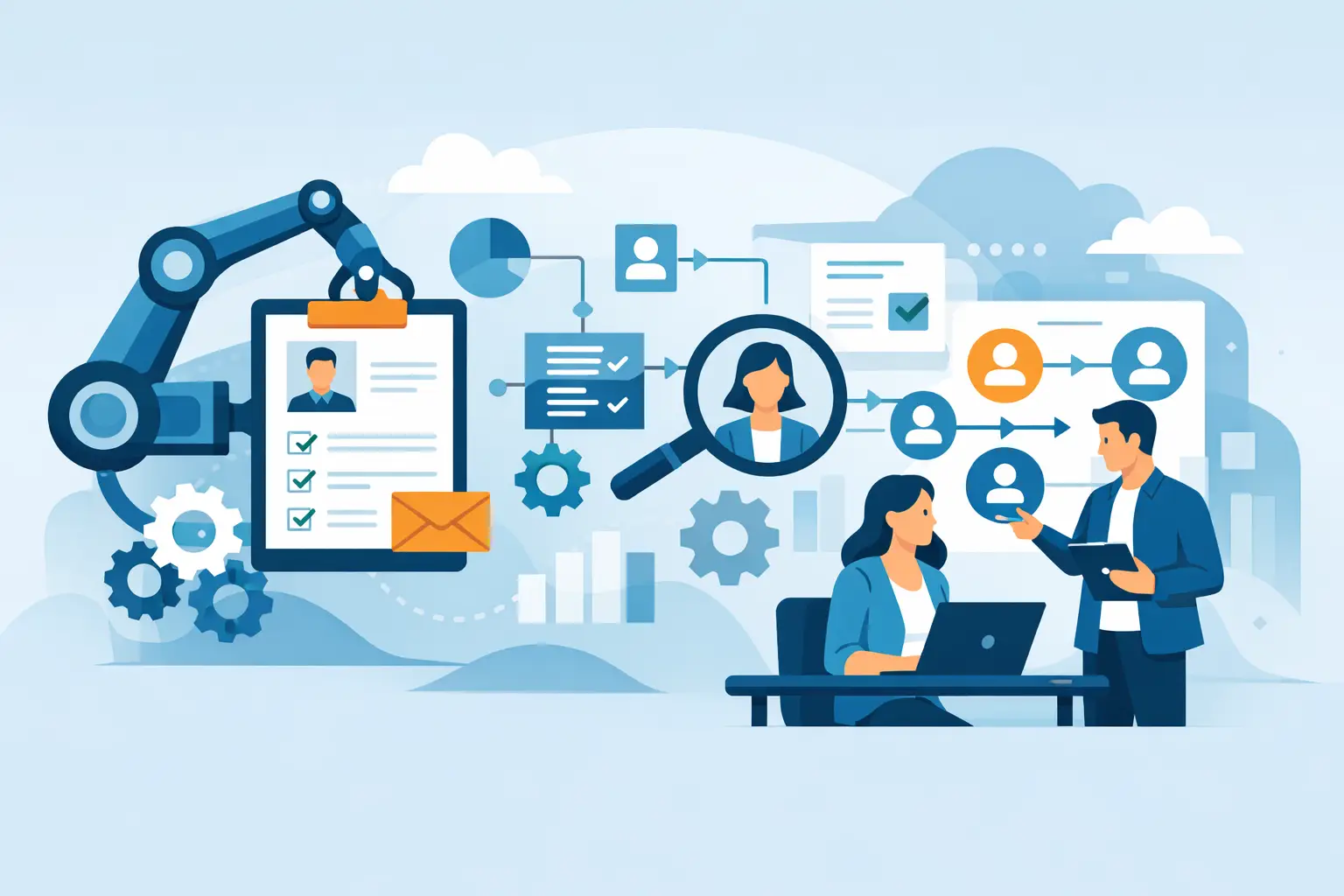
When HR managers work between excels, emails, manual forms and systems that don't talk to each other, every simple action becomes a cumulative delay. Automation for HR processes is designed to solve exactly this problem - not as another technological layer, but as a way to run organizational processes faster, with fewer errors and with better control throughout the entire employee life cycle.
Where automation for HR processes really creates value
The value does not begin with the automation itself, but with the friction points it removes. In medium and large organizations, most of the load does not stem from one complex task, but from hundreds of small repetitive actions: opening an employee, receiving documents, manager approvals, reminders for evaluations, collecting feedback, updating statuses, and documentation in the employee's file.
When each of these operations is done manually, the organization pays twice. Once during the working hours of HR and managers, and a second time due to inconsistency. A forgotten document, an incomplete assessment, delayed reception, or information found in one system but not in another - all of these affect performance, service to managers, and sometimes also meeting control and compliance requirements.
Good automation replaces manual coordination work with an orderly workflow. Instead of chasing people, the system drives the process. Instead of asking where each step is, you can see it. Instead of collecting data from several sources, work from a single work environment that centralizes the information and links the existing systems in the organization.
The processes you should start with
Not every HR process should be equally automated. There are processes in which the level of standardization and repeatability is high, so the benefit is faster and clearer.
Employee recruitment and offboarding
This is usually the first place where gaps are identified. Absorption of a new employee involves forms, documents, approvals, tasks for managers, equipment, permissions, and sometimes also an interface with payroll or ERP. Without automation, it is a chain dependent on people. With automation, you can run a predetermined process by role, unit, location, or transaction type.
The same principle also applies to closing the deal. Orderly offboarding is just as important as onboarding, especially in terms of control, documentation, closing privileges and organizational knowledge. An organization that does not manage these steps automatically relies on personal memory, which is an unnecessary operational risk.
Employee evaluations and performance management
Evaluation processes often suffer from the same problem: good organizational direction, weak manual execution. Managers don't complete on time, forms are sent in different versions, and the information isn't saved in a way that allows for comparison, tracking or generating insights.
Automation allows you to define evaluation cycles, trigger tasks according to schedules, collect feedback from multiple sources, keep everything in the employee's file, and present a consistent image to managers and HR. When you also add AI-based summaries and recommendations, you get not only a reduction in work time but also a layer of assistance that increases the quality of management - as long as human control over the decision itself is maintained.
Document management and [digital employee file] (https://www.b2e.co.il/products/hr-system)
A work file scattered among emails, drives and partial systems is a classic weak point. Automation in this process is not limited to uploading files to the cloud. The real value is in the ability to manage document validity, require completion, generate reminders, activate approvals, and connect each document to the correct event in the employee's life cycle.
When all this happens in an orderly structure, HR doesn't just keep information - it activates it.
What is the difference between spot automation and a system that works correctly
Many organizations already use different tools to create forms, send reminders or manage tasks. The problem starts when each solution handles a different part of the process, without a full operational context. The result is a collection of small automations, not a uniform work system.
A fundamental difference exists between an automatic operation and an automatic process. An automated action can send an email. An automated process also knows who initiates, what the conditions are, what information is pulled from other systems, who approves, where the documentation is kept, and what happens if a task is delayed.
Therefore, when considering an automation solution, the right question is not only what can be run automatically, but whether the system provides end-to-end control. This includes visibility into status, business rules, permissions, integration with payroll and ERP systems, and alignment with the corporate language and actual work structure.
Where automation fails
Not every automation project achieves results. In many cases, the failure is not technological but design.
When you file, the process is not as efficient as it is
If a cumbersome process is digitized without being validated, the organization simply gets a faster version of an existing problem. Before defining workflows, one should ask who really needs to approve, what information is really required, and where there are duplications that can be removed.
When there is no uniform source of information
HR cannot work effectively when employee data is scattered. Automation based on partial information will produce partial results. Therefore, one data center per employee - which is connected to the touch systems - is not a nice addition but a basic operational condition.
When there is no adjustment to the level of organizational complexity
A small organization can get by with basic processes. An organization with several subsidiaries, business units, different management hierarchies and strict control requirements needs a system that knows how to deal with complexity, not bypass it. Here the ability of the platform to define conditions, stages, permissions and exceptions is tested without turning any change into a development project.
How to choose an automation solution for HR processes
The right choice starts with practice, not a presentation. Instead of asking what features exist, you should check which processes can be put on the air quickly, who will maintain them, and how they will fit into the existing infrastructure.
First, it is important to check implementation time. If the organization takes months just to run a basic process, the business value is rejected and the burden remains. Second, the depth of integration must be examined. An HR solution that does not connect to core systems leaves staff members with double work.
Third, the work experience of managers and employees should be examined. Even the most advanced system will not achieve results if it requires too much effort, is not suitable for mobile, or does not show users only what is relevant to them. And fourth, it is important to ask what the control looks like. Is it possible to know what has been completed, what is stuck, who approved, and what is missing - in real time.
It is precisely at this point that the advantage of an integrative platform like B2E stands out, which connects a digital employee portfolio, assessments, surveys, organizational portal and Workflow under one cloud environment. Instead of managing disconnected layers, the organization operates a continuous HR process with a complete picture.
The administrative impact is broader than saving time
The common mistake is to measure automation only by hours saved. This is an important measure, but it is not the only one. In practice, automation changes the quality of management.
When a manager has immediate access to employee data, open tasks, documents, previous assessments and current recommendations, the level of decision-making increases. When HR sees bottlenecks in real time, it can address them before they become an organizational problem. And when management accepts a consistent and measurable process, it is easier to demand performance and improve it over time.
There is also a cultural aspect here. An orderly process conveys to the employees that the organization is conducted in a serious, consistent and fair manner. Better uptake, clearer internal communication, and timely assessments - these are not just operational matters. These are factors that affect employee experience, trust, and the organization's ability to grow without losing control.
Not everything has to be automatic
It's worth saying this clearly: HR is not an assembly line. There are decisions that should remain human, especially in the areas of managerial conversation, professional judgment, organizational sensitivity and labor relations.
The goal of automation for HR processes is not to remove the people from the process, but to remove the unnecessary burden from them. The system should manage scheduling, documentation, reminders, control and information transfer. The managers and HR people should remain responsible for the judgment.
This is also where AI needs to be examined soberly. Automated summaries and recommendations can shorten work and provide direction, but they do not replace managerial responsibility. A smart organization will use them to speed up a process, not to hand over the decision to the system.
The right move usually starts with one process that has obvious pain, high workload and heavy reliance on manual coordination. When you choose correctly, the effect is felt quickly - less burden, more transparency, and more consistent execution. From there it is easy to expand, because the organization not only implements a new system, but builds a better way of working.