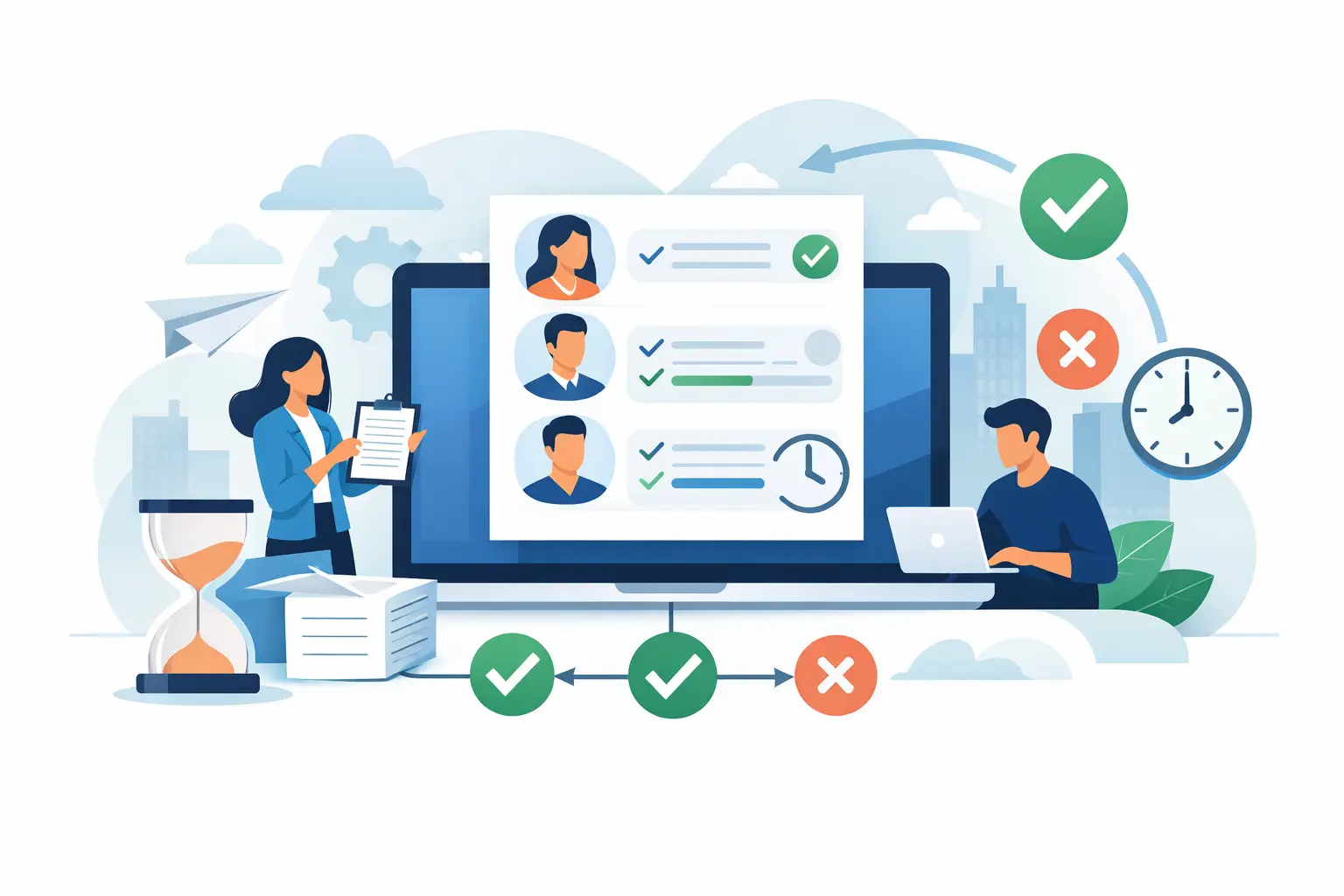

A purchase request sits for a week. Leave is approved after the dates no longer matter. A performance review stops with a busy manager. An employee-detail update passes through three people. These are signals. Spotting organizational approval overload early keeps a control step from becoming an operating block, a poor employee experience, and a slower management decision.
Approval load does not mean the organization has too much control. Control is a business need around budgets, privacy, compliance, pay, and people decisions. The problem starts when the approval path ignores risk, amount, request type, or the authority that already exists. The mechanism meant to protect the organization then creates waiting, duplicates, and unclear ownership.
What organizational approval overload looks like
Organizational approval overload shows up when a simple request passes through too many approvers, when requests reach people who lack the information or the authority to decide, or when nobody can see where a request sits and why it is late. Sometimes an old policy stayed in force after the org chart changed. Sometimes each step lives in email, a spreadsheet, or a separate tool.
The cost is wider than handling time. Managers spend hours on routine requests. HR chases approvals and answers status questions. Employees learn to bypass the process, or to submit early just to have a chance of an on-time answer. Data quality suffers too, because decisions, exceptions, and reasons stay outside the organizational system.
How to read organizational approval overload in the data
A reliable diagnosis follows the request from submission, through every approval stop, to the action that was supposed to happen. That path shows whether one person was late once, or whether the pattern is systemic.
Uneven approval times
The first signal is a wide gap in handling time for similar requests. If a work-from-home request is approved in hours in one case and after two weeks in another, manager availability is only part of the check. The request may be routed to people who are not required every time, or the rules may be unclear enough that each approver adds a private review.
Measure median handling time, and look at the average as a second view. An average can hide a small number of badly stuck requests. Also measure wait time at each stop: who approves quickly, which units create bottlenecks, and which request type waits the longest.
Too many handoffs, returns, and reminders
A request returned for missing information can be a normal step. A document may be missing, or a reason may be required. When the same request type comes back again and again, the form, the instructions, or the route is the likely source.
Reminder volume is a measure too. If HR sends the same manual reminders to managers, the process depends on personal chasing. An automatic reminder after a defined wait, with escalation to an alternate approver when needed, reduces that dependence and keeps control.
Approvers who cannot actually decide
Large organizations add approvers "for information" or to reduce risk. A person with no budget, professional, or management authority then receives requests, delays them, and sometimes approves without reviewing them. That step does not produce effective control.
For each stop, ask what decision is made there, what unique information the approver has, and what risk remains if the stop becomes a notice. If there is no clear answer, the stop needs a change.
Work that leaves the system
When employees message a manager instead of submitting a request, or managers approve by email and ask the team to update the system later, people are already voting with their behavior. Often this is a practical response to a slow or clumsy process.
Bypasses create two risks. They damage the record and the ability to audit. They also distort handling-time analysis. A request approved outside the system can look fast, while the employee waited days for an undocumented answer.
Keep control, and remove friction
The aim is a path that matches risk and accountability. A pay change, access to sensitive information, or a budget exception usually needs more than one step and a full record. A personal-detail update, a low-cost equipment request, or approval for routine training can take a much shorter path.
The balance comes from rules set in advance. An extra budget approval can apply only above a set amount. HR can enter the path only when a request breaks policy. A delegate can receive authority automatically when the direct manager is on leave. Control stays, and it does not hold every case to the same length.
Map the process people actually run
Map the process as it happens, before you automate the policy version of it. An approval process system depends on that map. Choose three to five frequent, high-impact processes, such as hiring, an exception leave request, a performance review, a role change, or a team purchase. For each one, record who submits, who approves, what information each step needs, the target time, and what happens when nobody responds.
Mark four states: a required approval, a conditional approval, a notice, and a duplicate approval. A required approval is a step the process cannot pass. A conditional approval fires only from the request data. A notice should not stop the process. A duplicate approval is two people checking the same thing. That split removes friction and keeps governance.
Make the workflow a management view
A useful workflow system shows managers and HR a status picture: which requests are open, where they are stuck, how long they have waited, which exceptions repeat, and how much approval load sits with each approver.
When employee data, org structure, role, direct manager, and payroll information share one workplace, routes can follow the current structure. An employee who changed roles should not depend on an old distribution list. The system can send the request to the role that owns it now.
AI can help and still leave the decision with a person. It can spot delay patterns, summarize what was entered in a review, or highlight exceptions that need attention. The final decision, especially on people and budget, stays with the authorized role and inside the governance rules the organization set.
Measures worth showing leadership
Judge an approval improvement by business value. Useful measures include median handling time by request type, the share of requests past the target time, the number of returns for missing details, the escalation rate, and the volume of requests approved outside the system.
A connected platform such as B2E's HR system can run the approval next to the employee file, reviews, and operational data, so the approval is part of a recorded, measurable process.
Approval overload is resolved when the organization reads the data, assigns a clear owner to each decision, and updates the flows as the work changes. When an approval reaches the right person, with the right information, at the right time, control stays strong and the work continues.