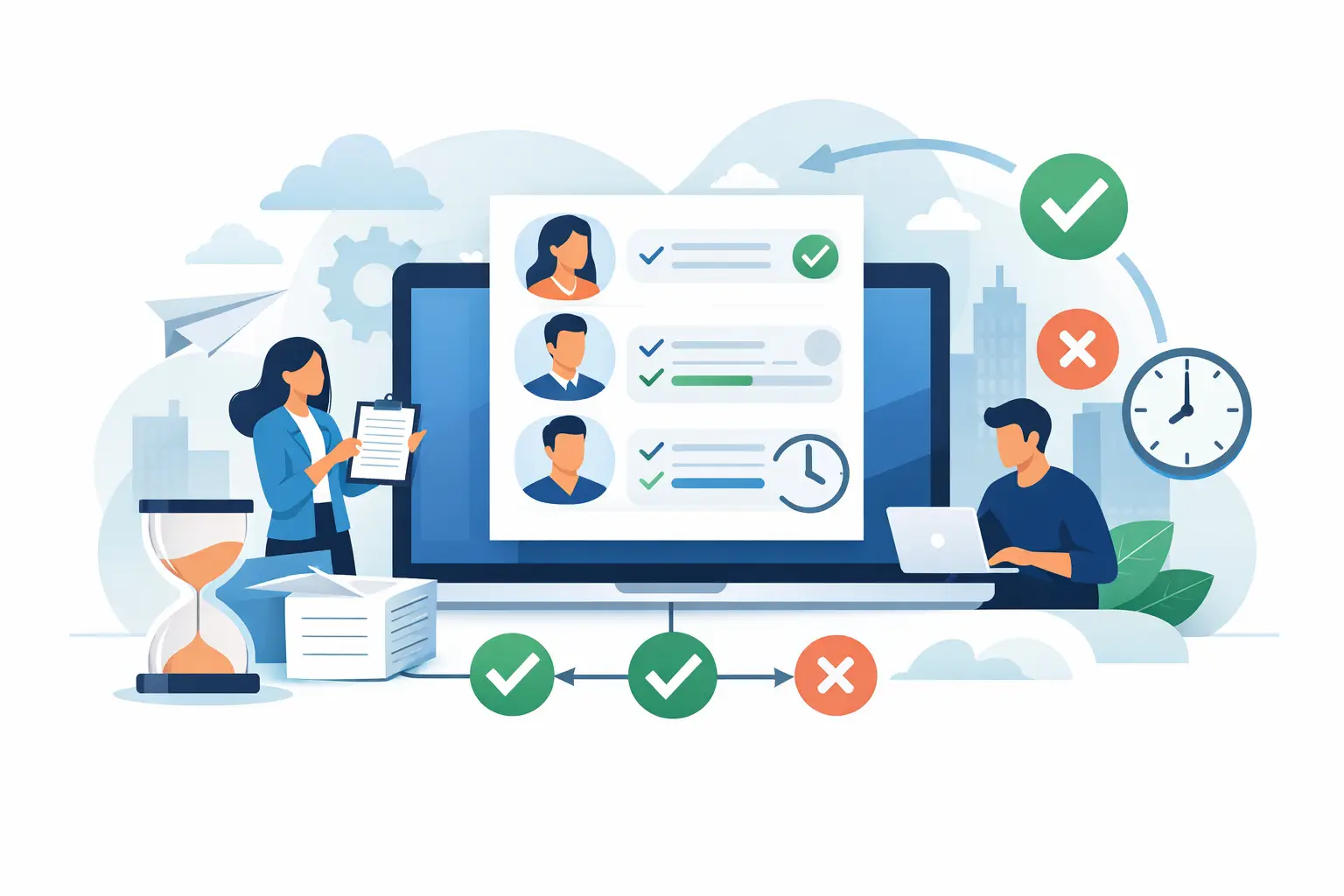
What is organizational workflow automation?
Workflow automation is digitizing repeatable work: request, approval, reminder, archive and a metric. Without a system, the process lives in email and spreadsheets — no source of truth, no permission model, no measurable cycle time.
B2E runs automation on employee identity: who asks, who approves, what is stored on the file. That is the gap between a generic form tool and an HR automation platform. More: automation solutions and HR automation platform.
Which processes to automate first
Start with a weekly process that has an owner: onboarding, hiring request, data change, leave approval, small internal procurement or a signature round. Measure cycle time and completion rate before and after. One stable process beats ten dead forms.
HR processes connect to the employee file and digital forms. Cross-organization approvals are covered in approval process management.
What a workflow system must include
A no-code process builder, conditions and logic, multi-step approvals, reminders, a status dashboard, archive and search, and mobile access. The critical piece: write-back to an employee record or process record — not a file in email. Without that, automation creates digital clutter.
B2E adds role- and unit-based permissions, SSO, and execution reports. Managers see bottlenecks; HR stops chasing signatures.
Automation without replacing every system
A workflow system does not replace payroll, ERP or email. It connects them: employee data in, approval runs, result returns to the file or the target system. Start with one module — forms or onboarding — and expand.
Broader guides: HR process automation and connecting HR systems.