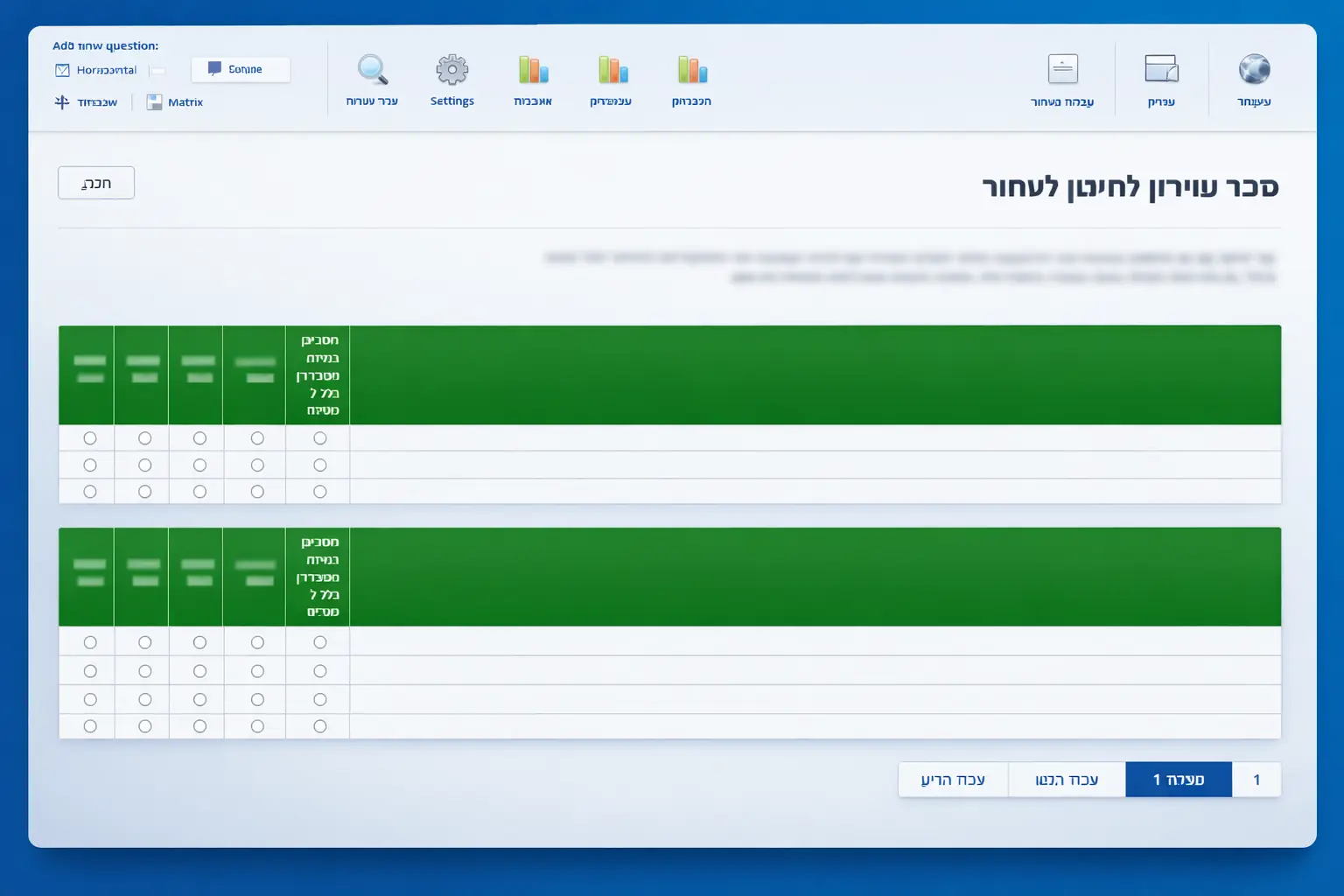

An employee leaves, a manager is surprised, and the HR team discovers only in the exit interview that there were clear signs months earlier. This is exactly the gap that digital employee surveys are meant to narrow: moving from periodic, disconnected feedback collection to continuous data management that makes it possible to identify problems, prioritize treatment, and make decisions based on a full organizational picture.
In a medium or large organization, employee sentiment is not a single data point. It is influenced by direct managers, workload, promotion processes, internal communication, working conditions, and dozens of touchpoints throughout the employee life cycle. When information is collected in spreadsheets, in separate survey tools, or in undocumented conversations, it is hard to see trends and act in time. A digital system connects feedback to an orderly work process, to the right people, and to data that already exists in the organization.
Why digital employee surveys require more than a question form
Moving to digital is not just replacing a printed questionnaire with a link. The real value is created when the survey is part of the work environment of HR and managers. The employee gets a simple experience that is also accessible on mobile, the manager sees a picture relevant to their team, and the HR team gets the ability to compare units, periods, and employee groups - without exporting files and building manual reports every time from scratch.
A good survey is also not necessarily a long survey. A broad annual survey can provide a strategic situational picture, but it does not replace short checks throughout the year. Pulse surveys, for example, can check change after a reorganization, the rollout of a new policy, the onboarding of a manager, or a period of unusual workload. The right choice depends on the question the organization is trying to solve, not on how many questions can fit on the screen.
The central challenge is to turn answers into action. If employees invest time in responding but do not see change, participation rates drop and the feedback loses credibility. Therefore, every survey initiative should also include in advance clear ownership of handling findings, timelines, and follow-up communication to employees.
Which types of surveys create operational value
A survey is well connected to the organizational process in which it is run. Instead of settling for a general satisfaction metric, it is right to combine several measurement points that make it possible to understand the employee experience over time.
An engagement survey examines the employee's connection to the organization, the role, and the manager. It is suited to identifying broad trends such as trust in leadership, a sense of meaning, or willingness to recommend the organization as a place of work. Onboarding surveys check the employee's first days and months, and make it possible to identify gaps in training, equipment, system access, or connection to the team.
Surveys after training or an internal organizational event check not only whether participants enjoyed themselves, but whether the content was relevant and whether the ability to apply it at work was created. Exit surveys, by contrast, provide important information on the reasons for leaving - but they are a late tool. An organization that relies only on them gives up the opportunity to intervene while it is still possible to retain an employee or improve the work environment.
In some cases a fully anonymous survey is required, mainly on sensitive topics such as a sense of safety, fairness, or managerial conduct. In other cases, such as feedback on onboarding or training, identifying the employee actually enables personal and fast handling. The decision should be transparent in advance: what is collected, who can see the data, and what action will be taken following it.
What turns survey data into a useful management picture
An average score is a starting point, not a conclusion. If the engagement metric has dropped, a manager needs to know where the decline is concentrated, whether it is related to tenure, site, department, or a specific organizational change. Analysis by segments makes it possible to distinguish between a local problem, which requires work with a specific manager and team, and a broad trend that requires organizational policy.
This is where the advantage of an integrated platform comes in. When survey data connects to the digital employee file, to the organizational structure, to tenure data, and to evaluation processes, feedback can be examined in the right context. For example, it is possible to identify teams where engagement metrics are low and absence rates have also risen, or to check whether new employees consistently report onboarding gaps in a particular unit.
This connection is not meant to create over-monitoring of employees. Its purpose is to reduce guessing and direct managerial attention to the places where intervention is required. The better permissions are defined and information is presented according to role, the organization preserves both employee privacy and the ability to act.
Metrics worth defining in advance
Before sending the survey, it is important to set what will count as success and what will be checked afterward. A high response rate is a sign of trust and accessibility, but on its own it does not indicate the state of employees. You should also examine change relative to the previous measurement, gaps between groups, the volume of open answers, and topics that repeat themselves.
An action metric is also essential: how many managers held a follow-up conversation with the team, how many improvement plans were opened, and what actually progressed. Without such a metric, the survey may become another report instead of a management tool. Systems that include workflows and alerts can assign a task to a role holder, set a due date, and document the handling status in the same place where the finding was observed.
Correct planning of the questionnaire and distribution
A precise questionnaire respects the employee's time. Every question should serve a possible decision. If it is not clear what the organization will do in the case of a low or high score, the question may not be necessary. Closed questions make it possible to identify trends over time, while open questions explain the story behind the numbers. Combining them is usually more effective than relying on only one of them.
It is advisable to use simple language, avoid double-barreled questions, and phrase each statement sharply. For example, the question "Are you satisfied with your salary and your manager?" does not make it possible to know what the source of the problem is. It is better to separate the topics and give the employee the option to add context when needed.
Distribution timing also matters. Sending a survey at the peak of a busy period, close to a holiday, or during a significant organizational change may skew the results or hurt the response rate. There is no single rule that fits every organization, but it is desirable to create a fixed measurement calendar and maintain consistency so that comparison over time is possible.
The common mistake: collecting feedback without closing the loop
Many organizations invest in launching a survey, drafting questions, and an internal campaign, and then stop at the presentation. From the employee's perspective, this is the most important message: whether someone listened and whether something changed. Even when it is not possible to implement every request, it is possible to share the main findings, explain what is being handled, and note what will not change for now and why.
This communication should happen at two levels. Leadership and HR need to present organizational trends and the broader moves. Direct managers need to run a focused conversation with their team, choose one or two topics for improvement, and come back later with an update. A small action done consistently builds more trust than a general promise of change.
Choosing a system that holds the process end to end
A standalone survey tool may fit a point need, but in an organization that manages a complex employee life cycle it sometimes creates yet another disconnected data repository. An organizational system should enable building questionnaires, distribution by populations, mobile support, anonymity by configuration, dashboards, and permissions. Beyond that, it should connect to the organizational structure and existing HR processes.
In a platform like B2E, surveys can integrate alongside the employee file, evaluation processes, an organizational portal, and automations. In this way it is possible not only to present findings, but to run a follow-up process: notify managers, assign tasks, document conversations, and examine impact in the next measurement. Integration with payroll or ERP data can broaden the picture, provided that data use is defined according to privacy policy and permissions.
The choice is not between an annual survey and continuous measurement, and not between anonymity and personal handling. A mature organization combines the tools according to the goal, the level of sensitivity, and its ability to act. When feedback is connected to data, to role holders, and to follow-up processes, it stops being a communication event and becomes part of the organization's operating system.
The right step is not necessarily to send another survey. It is to define a clear business or organizational question, choose a measurement that fits it, and commit in advance to the action that will follow. That way employees get proof that their voice matters, and management gets information it can manage with.