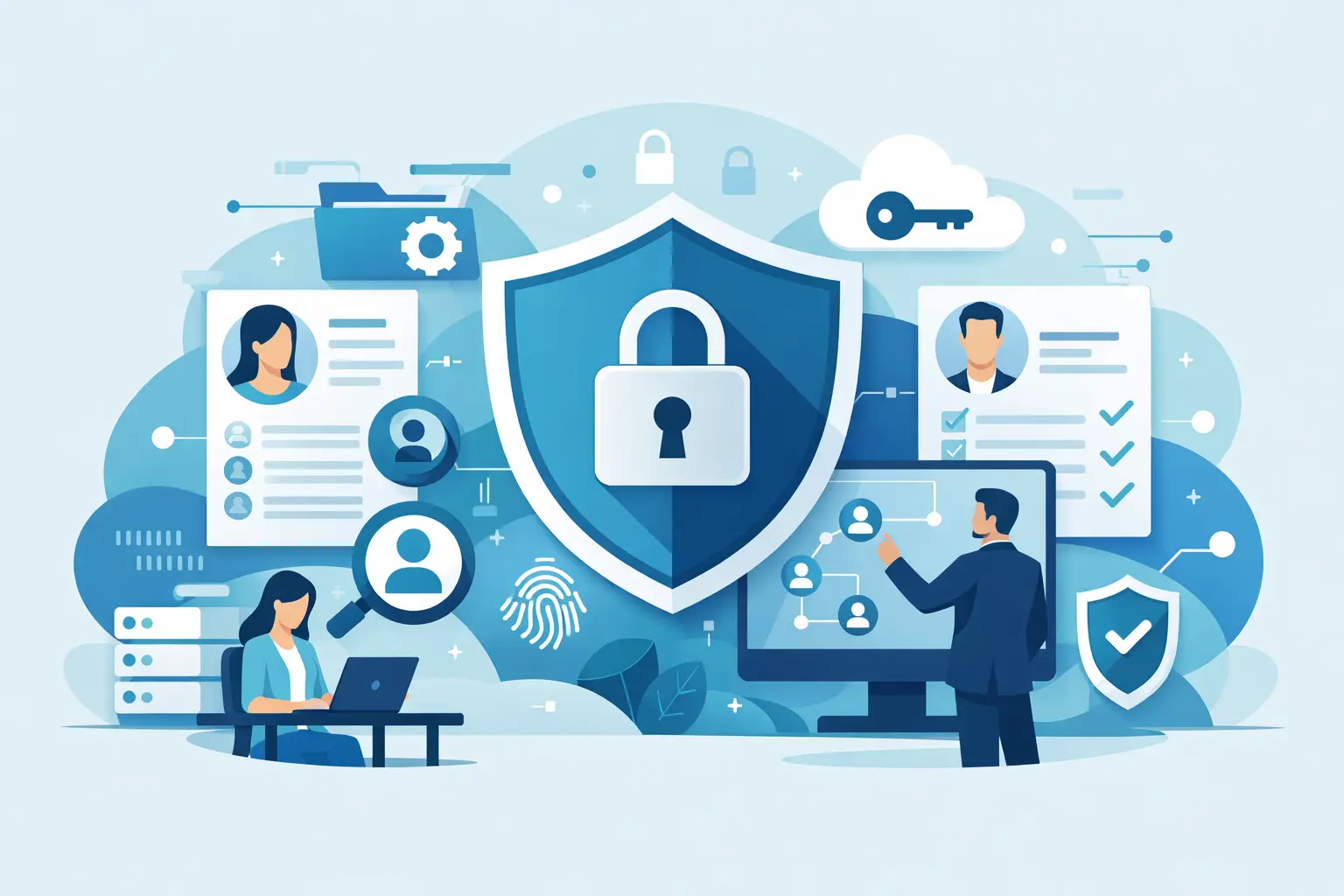
A digital employee file centers salary decisions, performance evaluations, medical documents, bank details and sometimes also sensitive disciplinary information. Therefore, information security in the human resources system is not an IT layer that is added after implementation, but a basic condition for responsible employee management, reliable decision-making and maintaining employee trust.
As the HR system is connected to payroll, ERP, attendance, the corporate portal and evaluation tools, its operational value increases - but so does the need for clear governance. An organization needs to know not only where the information is stored, but who can see it, in what context, for how long and what happens when the role of an employee or manager changes.
Why the human resources system is a particularly sensitive target
HR systems hold a rare combination of personal, business and operational data. Unlike a single system that contains only contact information or only salary data, a central HR system presents a complete employee picture: contracts, seniority, roles, goals, feedback, training, absences, approvals and promotion processes. Uncontrolled disclosure of such information may harm the employee's privacy, create a legal risk and undermine the managers' trust in the decision-making processes.
The risk does not come only from an external attack. In many cases, the point of failure is too broad a permission given to an internal user, an employee's account that left and was not neutralized in time, a file that leaves the system without control, or an integration interface that is not properly managed. Therefore, the right question is not whether the system is secure in general. The question is whether any access to the data is justified, documented and limited to its business need.
Information security in the HR system starts with permissions
An effective authorization model should reflect the organizational structure and actual work processes. A direct manager needs access to the information necessary to manage his staff, but usually does not need to see salary data, personal documents or evaluations of employees outside his unit. An HR team needs a wider view, while a payroll accountant, training manager or welfare officer only needs a specific part of the picture.
The most accurate approach combines role-based permissions with context-based permissions. That is, not only "manager" or "HR", but also to which site, subsidiary, department, employee and process the user is associated. In this way, it is possible to allow the manager to approve a vacation or to perform a performance evaluation for his staff, without opening to him information from other units.
There are compromises here too. Too rigid permissions create a burden on the HR team and slow down processes. Permissions that are too broad are a shortcut, but increase the area of exposure. The solution is not to choose one of the extremes, but to build clear authorization templates, approved exceptions and a regular process for checking access.
The need to know principle
The simple rule is that a user should receive only the information he needs to perform a specified task. This principle is particularly relevant to sensitive processes: hiring an employee, changing wages, disciplinary investigation, evaluating managers, terminating employment or handling medical documents.
In practice, it is useful to define in advance which fields, documents and actions are available in each process. An administrator may be able to see a missing document status, but not open the document itself. An employee may be able to update personal details, but a change in bank details will require additional approval. These small distinctions are sometimes the difference between a convenient system and a system that relies only on trust.
User identity is the first line of defense
A password alone is not sufficient for a system that contains a large amount of organizational and personal information. Multi-step authentication, password policies, device management and secure login are necessary components, especially when managers and employees access the system both from mobile and outside the corporate network.
You should connect the human resources system to the corporate identity management, when possible. Such a connection makes it possible to implement a uniform access policy, reduce duplicate accounts and deactivate a user quickly when an employee leaves. However, integration is not exempt from control. It must be checked that the job definition in the identity system is indeed translated into the correct permissions in the HR system.
The process of receiving and closing the deal is an excellent test. At reception, the account should be opened only after proper authorization and with the necessary permissions for the role. When leaving, disable access immediately, transfer responsibility for open tasks, and ensure that no local accounts, mobile access, or unusual permissions remain active.
Data protection both while moving and at rest
The information in the human resources system passes between users, modules and external systems. It is entered from payroll, synchronized with ERP, displayed in the employee portal and sometimes sent for approval or signature. Therefore, encryption is required both when transferring information and when saving it.
But encryption is only part of the picture. An organization needs to understand where data is hosted, how it is backed up, what the recovery policy is, who is authorized to access operational and support environments, and how development, testing, and production environments are separated. An Azure-based cloud infrastructure can provide a strong operational foundation, but the corporate responsibility remains: to define policies, choose the right configuration and test the application over time.
Saving data is also important. Not every document needs to be kept forever, and not every historical data needs to remain available to every user. Deletion, archiving and retention policies should take into account regulatory requirements, auditing needs and the need to reduce sensitive information that is no longer needed.
Integrations are both an operational asset and a control point
The connection between HR, payroll and ERP prevents double entry and provides an up-to-date employee picture. But each interface creates an additional path for information transfer. If a department, salary or employment status update comes from another system, it must be defined who is the source of the truth, what information passes, how often, and how an error or contradiction is handled.
Proper management of interfaces includes dedicated identification for each integration, minimum privileges, documentation of operations and failure control. There is no reason for an interface designed to update an employee number to have access to the entire employee file. This separation reduces the scope of possible damage even if the access credentials of a particular interface were exposed.
It is also important to examine the export process. Excel reports and downloadable files are sometimes necessary, especially in payroll audits or preparing management discussions. Instead of blocking them comprehensively, it is better to determine who is allowed to export, which fields are exported, whether the operation is recorded, and whether it is possible to generate a secure report within the system instead of transferring a file between parties.
Documentation and control turn policy into real control
Without logs, an organization has difficulty understanding what happened in the event of an exception. A corporate HR system should document significant actions: logging into the system, viewing sensitive information, changing details, updating permissions, downloading documents, approving processes and changes in salary or position data.
The documentation is not only for investigating an event. It allows for ongoing audits, identification of unusual usage patterns and proof of policy compliance. For example, if a user has viewed many employee files that are not in his area of responsibility, or if repeated exports have been made at unusual hours, alerting and quick review should be enabled.
It is useful to establish a clear ownership of the control. Information security, IT, HR and management cannot work separately. The HR team understands the sensitivity of the process and the required permissions; IT and information security understand identities, infrastructure and monitoring; The management determines the level of risk that the organization is willing to accept. The combination of them prevents a situation where a system is technically secure but does not fit the operational reality.
Using AI requires clear data boundaries
AI tool Summarizing assessments, identifying trends and recommendations for managers can save time and improve consistency in HR processes. However, when the information includes personal feedback and performance evaluations, it is necessary to carefully examine what is transferred to the tool, who can operate it, how the separation between organizations is maintained and what is the human control process of the result.
An automatically generated recommendation should not replace managerial judgment. It can help in locating points for conversation or in summarizing existing information, but decisions on promotion, compensation or treatment of an employee must remain transparent, explained and approved by a competent authority. This is also a security principle: to reduce exposure, use and distribution of sensitive information beyond the defined purpose.
Practical organization readiness test
Before declaring that the HR system is secure, you should make sure that the organization is able to confidently answer the following questions:
- Is there an up-to-date authorization map for each position, unit and sensitive process?
- Do employees who left or changed positions lose access in a timely and documented manner?
- Does each integration receive only the permissions it needs?
- Are data exports, salary changes and viewing of sensitive documents documented and checked?
- Is there a clear policy for saving, backing up, restoring and deleting information?
- Do managers and HR employees know how to identify impersonation attempts, unauthorized sharing and access violations?
A connected platform like B2E makes it possible to centralize work file, assessment processes, corporate portal and automations in one place. The business value of such concentration depends on the ability to manage it accurately: the same system that shortens processes must also ensure that each person sees only what he needs, at the time he needs it.
Good information security is not felt as another obstacle in the work process. When designed correctly, it allows managers to act faster, HR staff to work with reliable information, and employees to know that the organization takes their personal data as seriously as it takes its business decisions.